-
Quick Answer
Rental management software solves seven core operational challenges: (1) double bookings from unsynchronized availability, (2) inventory that is inaccurate or untracked at scale, (3) static pricing that misses peak-demand revenue, (4) customer communication gaps that cause no-shows and late returns, (5) slow paper-based check-in that creates counter bottlenecks, (6) poor staff coordination across locations and shifts, and (7) limited visibility into business performance. Platforms that address all seven in one connected system eliminate the manual workarounds that slow rental operations down and introduce costly errors.
When reservations arrive simultaneously through your website, phone line, walk-in counter, and any other channel you operate, keeping availability accurate becomes a guessing game. Consequently, the right rental management software solves these operational bottlenecks by centralizing everything in one platform — so your team stops patching gaps manually and starts running a predictable, scalable operation.
This guide breaks down each of the seven challenges in detail, explains exactly how software addresses it, and shows what to look for when evaluating platforms.
What Is Rental Management Software?
Rental management software is a cloud-based platform that centralizes bookings, inventory tracking, payment processing, customer records, staff management, and reporting for rental businesses in one connected system — replacing the spreadsheets, paper forms, and disconnected tools that most operators use to manage these functions separately.
Before examining what it solves, it is worth defining what rental management software actually is — because the term covers a wide range of tools with very different capability sets.
At the operational level, rental management software connects three things that most rental businesses manage separately: the booking layer (reservations, availability, channels), the inventory layer (equipment status, maintenance, utilization), and the customer layer (profiles, waivers, communication, payment history). When these three layers share a single database and update each other in real time, the manual reconciliation work between them disappears. Furthermore, reporting becomes possible across all three layers simultaneously — something no combination of spreadsheets can replicate.
The 7 Biggest Operational Challenges in Rental Businesses
1- Double Bookings and Reservation Conflicts
Double bookings in rental businesses occur when two reservations are confirmed for the same item at the same time because availability is not synchronized across all booking channels in real time. Rental management software prevents double bookings by maintaining a single availability pool that updates instantly the moment any reservation is placed, modified, or cancelled — regardless of whether the booking came from your website, phone, walk-in, or backend.
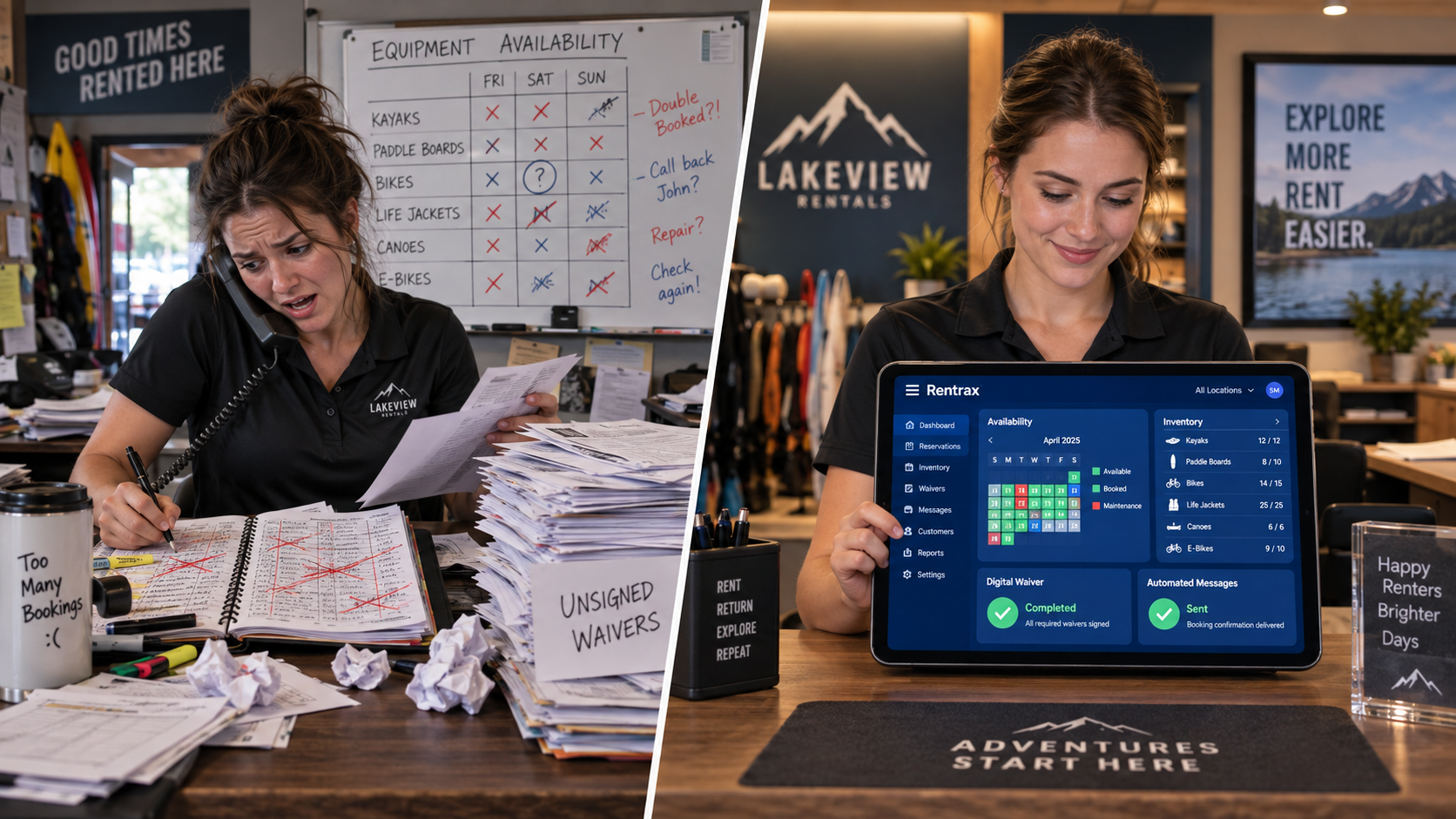
When reservations arrive simultaneously through your website, phone line, walk-in counter, and any other channel you operate, keeping availability accurate becomes a guessing game. One staff member confirms a kayak rental while another accepts an online reservation for the same kayak at the same time slot. Neither system told the other. The result is a phone call to a disappointed customer, a scramble to find a substitute, and a trust problem that outlasts the incident.
The fix is a centralized booking system with a single availability pool. When a customer books online, that item is immediately unavailable across every other channel — phone, walk-in, and backend — before a second confirmation can be issued. Cancellations reopen the slot automatically. Therefore, your team stops cross-checking availability before every confirmation and starts trusting the system to prevent conflicts before they happen.
2- Inventory That Is Inaccurate or Untracked at Scale
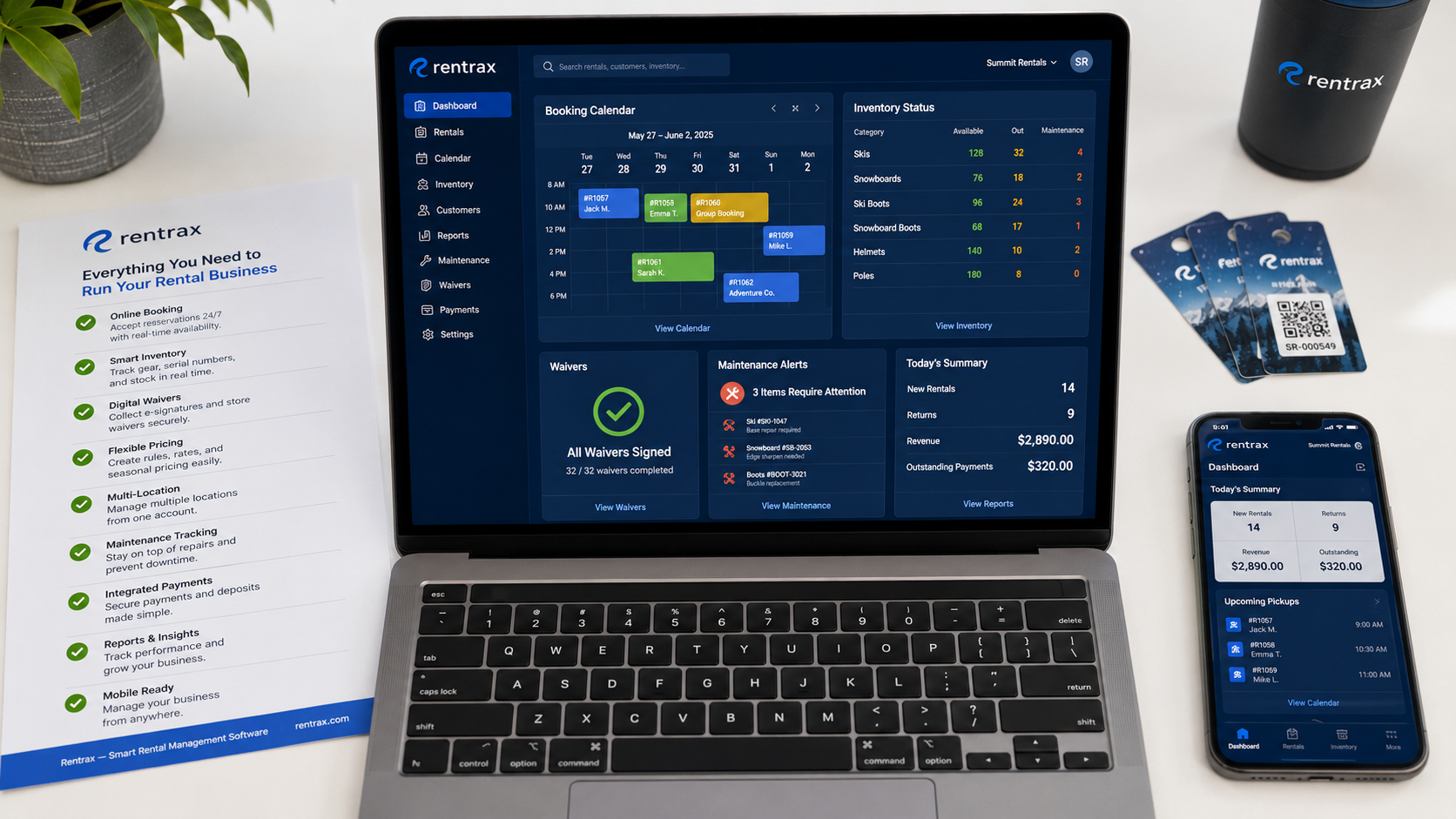
Manual inventory management in rental businesses — using spreadsheets, whiteboards, or paper logs — breaks down at scale because these systems cannot update in real time, do not reflect status across multiple locations, and cannot automatically flag maintenance needs. Rental management software replaces manual tracking with a live inventory dashboard that shows every item’s current status, location, service history, and utilization in real time.
Spreadsheets and whiteboards work for ten items. Once you grow past fifty, or begin operating from multiple locations, manual tracking becomes systematically unreliable. Equipment is checked out without being logged. Maintenance falls behind because no system flagged that a piece of gear had completed 200 rental cycles since its last service. You end up handing out equipment that should have been pulled from circulation weeks earlier.
Software gives you a live dashboard showing exactly what is out, what is available, and what is overdue for maintenance — updated automatically with every booking action. Usage monitoring logs mileage, battery cycles, and wear so you can catch problems before they cause a mid-rental failure. According to the American Rental Association, fleet management discipline is one of the clearest differentiators between high-performing and average rental operations. Moreover, it starts with accurate, real-time inventory data — not a spreadsheet someone updates when they remember.
3- Static Pricing That Misses Peak-Demand Revenue
Static pricing in rental businesses — charging the same rate regardless of demand, season, or day of week — leaves revenue unrealized during high-demand periods when customers would pay a premium and fails to stimulate volume during slow periods when lower prices would drive more rentals. Rental management software with dynamic pricing automates rate adjustments based on rules the operator configures once, capturing more revenue at peak demand without manual price updates.
Most rental operators set a price and leave it there. A bike rents for the same amount on a quiet Tuesday morning as it does on a holiday weekend when every bike in your fleet could go out at full capacity. This approach quietly erodes your revenue potential during your most valuable periods while doing nothing to move idle inventory during slow ones.
Dynamic pricing tools let you create seasonal rates, weekend premiums, early-booking discounts, and last-minute promotions that activate automatically based on rules you configure once. You capture more revenue at peak demand without manually updating prices every time the calendar changes. In addition, promotional pricing during slower periods converts downtime into revenue — moving inventory that would otherwise sit idle.
4- Customer Communication Gaps That Cause No-Shows and Late Returns
Customer communication gaps in rental businesses — absent booking confirmations, no pre-rental reminders, and no return notifications — directly cause no-shows, late equipment returns, and high support call volume that consumes staff time. Rental management software solves this by automating the full communication sequence from booking confirmation through return reminder, triggered from the booking timeline without any manual effort from staff.
Customers forget reservation times. They show up late, miss pickup windows, or no-show entirely. Meanwhile, your staff fields phone calls asking about hours, availability, and pickup instructions — calls that a single well-timed message would have prevented. Each no-show is lost revenue. Each support call is staff time that should be going to the customers in front of them.
Automated email and SMS sequences solve this at the source. Customers receive a confirmation when they book, a reminder the day before, pickup instructions the morning of the rental, and a return reminder a few hours before the equipment is due back. Specifically, each message pulls the correct name, equipment details, and timing from the booking record automatically — no manual follow-up required. No-show rates drop. Support call volume drops. And every customer interaction reflects a more professional, organized operation.

5- Slow Paper-Based Check-In That Bottlenecks Your Counter
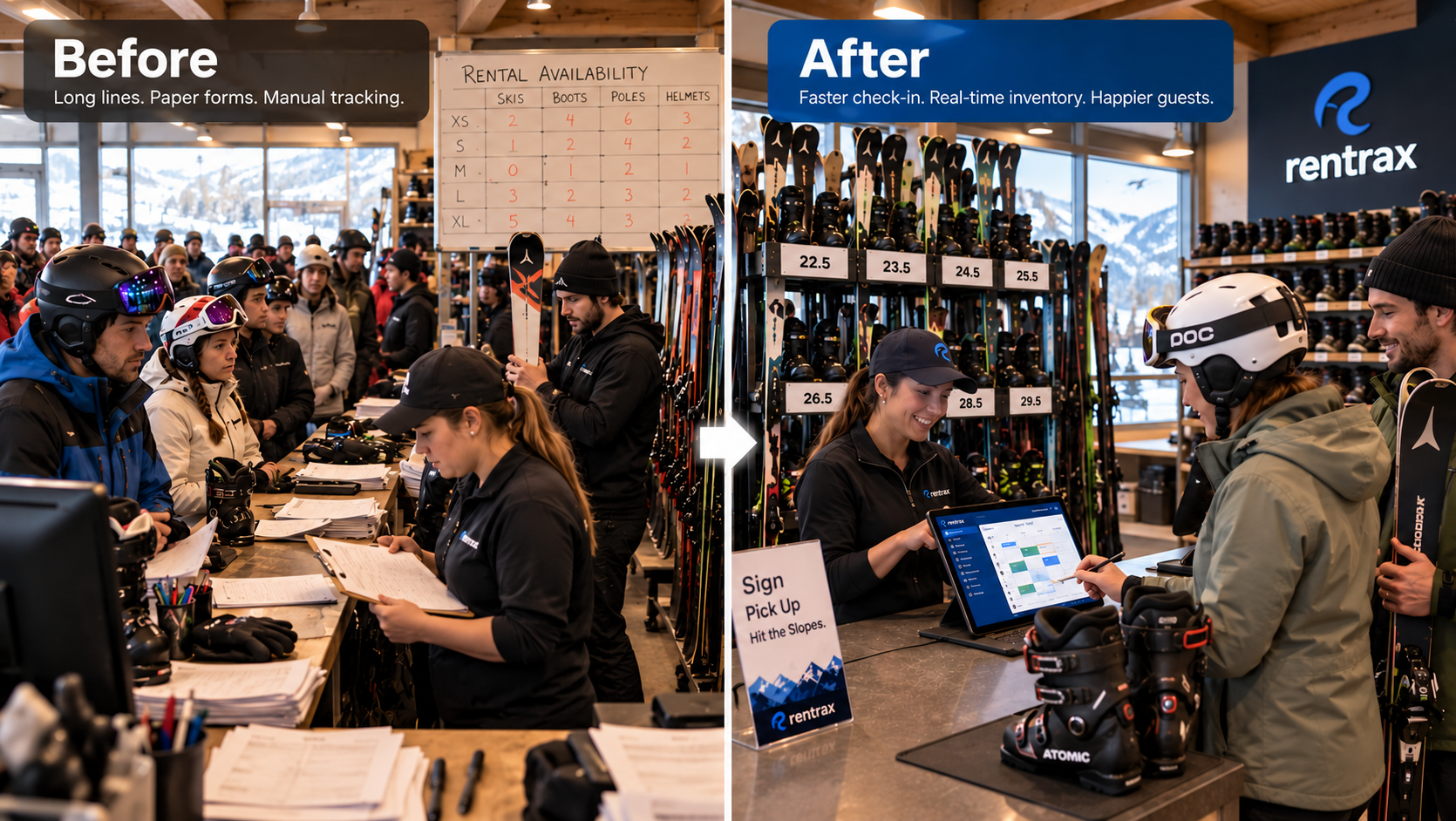
Paper-based check-in processes in rental businesses — printing waivers, collecting signatures at the counter, manually verifying IDs and processing payments — add several minutes per customer and create compounding delays during peak periods when volume is highest. Rental management software with digital waivers lets customers complete all paperwork remotely before they arrive, reducing counter time to equipment handoff.
Waivers, rental agreements, ID verification, payment processing: each step adds minutes to your check-in process. On a busy Saturday morning, those minutes stack into a line that tests customer patience before the rental even starts. Customers waiting while you print forms and locate a pen are not forming a positive first impression. During peak periods, these delays limit the number of rentals you can process per hour at a point when demand is highest.
Digital waivers with remote e-signature let customers complete paperwork before they arrive. They receive a link at booking, sign on their phone or computer, and show up with documentation already on file. Rentrax handles waiver collection with remote signing built into the booking flow — no third-party tool required. Signed waivers attach automatically to the booking record and customer profile, searchable and retrievable without a filing cabinet. As a result, your counter staff focuses entirely on equipment handoff.
6- Poor Staff Coordination Across Locations and Shifts
Staff coordination problems in multi-location or multi-shift rental businesses occur when reservation details, inventory status, and customer information are not shared in real time across teams. Rental management software with a shared dashboard and role-based permissions gives every staff member the same live operational data — regardless of which location they work at or which shift they cover — without requiring separate logins or manual communication between sites.
When you have multiple locations or rotating shifts, information silos form naturally. The morning shift does not know what the evening shift promised a customer. Your second location has no visibility into whether your main shop just ran out of a popular item. A seasonal hire makes a pricing error because a promotional rate was communicated verbally last week and never entered anywhere they could access.
A unified multi-location dashboard keeps every team member on the same page in real time. Staff scheduling tools ensure the right people are in the right place. Role-based permissions mean a seasonal hire can process rentals and check inventory without accessing financial reports or making configuration changes. Rentrax supports multi-location operations natively — managers see total activity across all sites, and staff see exactly what they need for their location and role.
7- Limited Visibility Into Business Performance
Without reporting tools, rental business owners make fleet investment, pricing, and staffing decisions based on memory and intuition rather than data. Rental management software surfaces revenue by item category and time period, equipment utilization rates, booking conversion patterns, and outstanding balances — giving operators the numbers they need to make decisions that improve margins, reduce idle inventory, and support sustainable growth.
Making smart decisions about your rental business requires data you probably are not collecting consistently right now. Which items generate the most revenue per rental day? What is your utilization rate across categories? What is your no-show rate, and which communication touch point would reduce it most? Without answers, every decision about pricing, fleet size, and staffing is a guess that sometimes costs you money and sometimes leaves it on the table.
Reporting tools answer these questions with exportable reports on revenue trends, inventory performance, and transaction history. You see which items earn the most relative to their cost, which categories are underperforming, which periods drive the highest demand, and where outstanding payments are sitting. Rentrax reporting gives rental operators this visibility across all locations and categories — so the next pricing or fleet investment decision is grounded in actual numbers rather than instinct.
How to Choose Rental Management Software That Solves All Seven
Not every rental management software addresses all seven challenges equally. Some tools focus heavily on booking but offer limited inventory management. Others handle inventory well but lack customer-facing features like online booking or digital waivers. As a result, operators end up patching the gaps with additional tools — which reintroduces the fragmentation the software was supposed to eliminate.
- Does it sync availability in real time across every booking channel simultaneously?
- Does inventory tracking work at the item level, with maintenance scheduling built in?
- Can customers sign waivers remotely before they arrive, with documents attached to the booking?
- Does it automate the full customer communication sequence without manual triggers?
- Can it manage multiple locations from one account with role-based permissions?
- Does it provide utilization and revenue reporting across your whole operation?
Rentrax covers all seven in one connected platform — built by a former rental business owner who experienced these exact operational problems and built the software to solve them. Over 5,000 rental businesses across 20+ countries use Rentrax to run their operations, with reported results of 67 percent faster booking times and 20 percent lower operational costs after switching.
Book a free demo to see how all seven challenges are handled in a single workflow. Or compare plans on the pricing page to find the right tier for your operation.

FAQs About Rental Management Software
-
What is rental management software?
Rental management software is a cloud-based platform that helps rental businesses manage bookings, inventory tracking, payment processing, customer records, staff coordination, and reporting from a single connected dashboard. It replaces the spreadsheets, paper forms, and disconnected tools that most operators use to manage these functions separately -- eliminating the manual reconciliation work and errors that occur when these systems do not communicate with each other. Rentrax is rental management software built specifically for equipment rental, tour, and activity businesses.
-
How does rental management software prevent double bookings?
Rental management software prevents double bookings by maintaining a single real-time availability pool that updates instantly whenever a reservation is placed, modified, or cancelled -- across every booking channel simultaneously. When a customer books online, by phone, or in person, the item's availability updates immediately everywhere else, so no second reservation can be confirmed for the same item and time slot regardless of how or where the booking originates.
-
Can rental management software handle multiple locations?
Yes. Rental management software with multi-location support lets operators manage separate inventories, pricing structures, staff teams, and booking systems for each physical location from one account, with a unified dashboard showing performance across all sites. Rentrax supports multi-location operations natively, with role-based permissions that control what each staff member can see and do at their specific location -- without requiring separate logins or manual data consolidation between sites.
-
How does rental software help with equipment maintenance?
Rental management software helps with equipment maintenance by tracking service history per item, logging usage metrics such as rental cycles and mileage, and automatically blocking equipment from new bookings when a maintenance window is scheduled. When the service is marked complete, the item becomes available again immediately. This prevents staff from accidentally renting out equipment that is due for inspection and gives operators a complete maintenance record for every asset in their fleet.
-
What types of rental businesses benefit from rental management software?
Equipment rental shops, tour operators, bike and scooter rentals, event suppliers, water sports providers, ski rental shops, construction equipment businesses, and any operation that rents physical items to customers can benefit from rental management software. The common requirement is that the business needs to track item availability across bookings, manage customer records and waivers, process payments, and report on revenue and utilization -- all operational functions that rental management software centralizes in one platform.
-
How do digital waivers in rental software speed up check-in?
Digital waivers in rental management software speed up check-in by letting customers sign rental agreements before they arrive, rather than at the counter. Customers receive a link by email or SMS when they book, review the terms, and sign on their phone or computer. When they arrive, their waiver is already on file and attached to their booking record -- reducing counter time to equipment handoff and eliminating the paper management, filing delays, and liability gaps that come with collecting waivers manually. Rentrax e-waiver handles this with remote signing built into the booking flow, with signed documents automatically attached to the customer profile.