-
Quick Answer
The highest-impact ideas for ski and snowboard rental businesses are: (1) digital DIN setting documentation to reduce binding-related liability exposure, (2) bundling course and lesson bookings with equipment rental in one order, (3) real-time multi-location inventory visibility for resort and mountain-town operators, (4) maintenance tracking for ski tuning and binding adjustments, and (5) group booking tools for families and ski schools. Operators who implement these together reduce risk while increasing revenue per customer.
Ski and snowboard rental is one of the highest-liability categories in the rental industry — and one of the most seasonally concentrated. A shop that gets its operations right during a 90-day winter window can have a profitable year. A shop that doesn’t can face DIN-setting liability claims, double-booked inventory across locations, and group bookings that take three times longer than they should. This post covers the operational ideas that actually move the needle for ski and snowboard rental operators — and the technology decisions behind them.
Idea 1: Eliminate DIN Setting Liability with Digital Documentation
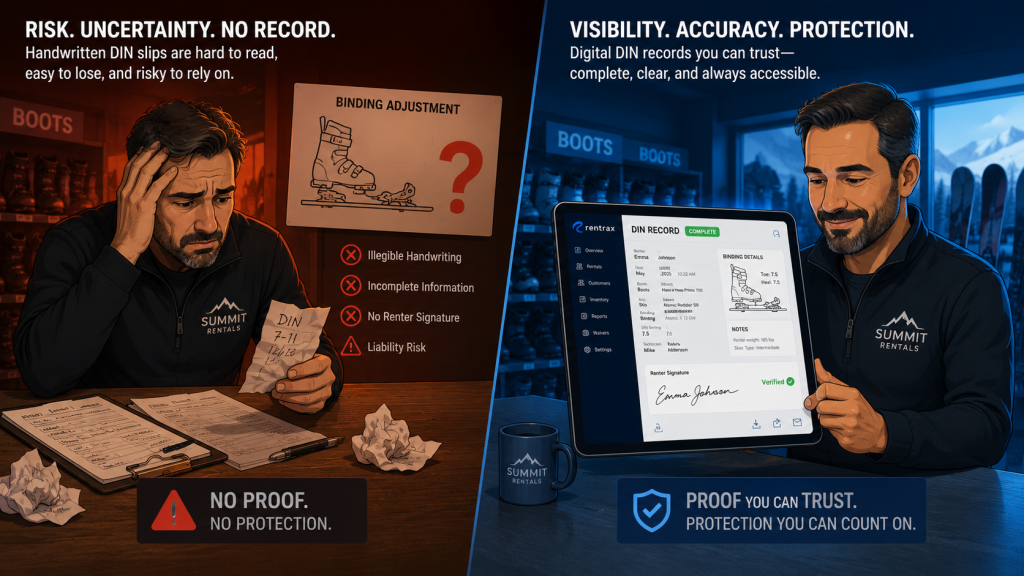
DIN setting is the single highest liability exposure in ski rental. The binding release force has to be calibrated to the skier’s weight, height, age, ability level, and boot sole length — get it wrong, and a binding either releases too early (a fall) or not early enough (an injury). When a customer is hurt and the shop’s only record is a handwritten paper slip that may or may not still exist, that’s a liability problem waiting to happen.
Digital DIN documentation tied directly to each rental record — calculated, recorded, and signed off by the renter before they leave the shop — creates an unambiguous record that protects both the customer and the business. It also speeds up the fitting process itself, since the calculation and the paperwork happen in the same flow instead of two separate steps.
- DIN value calculated and stored against the specific binding, not just the rental order
- Renter acknowledgment captured digitally at the point of fitting, not on a separate paper form
- Full DIN history retrievable instantly if a dispute or insurance claim arises later
- Staff trained on a consistent digital workflow reduce calculation errors versus manual lookup tables
Idea 2: Bundle Course and Lesson Bookings With Equipment Rental
A beginner booking a ski lesson almost always needs equipment too — but if your booking flow treats the course and the equipment rental as two separate transactions, you’re creating friction at exactly the moment a new skier is deciding whether this sport is worth the hassle.
The shops that convert lesson bookings into equipment rentals (and vice versa) are the ones where a single booking flow handles both: pick a course time, equipment is reserved automatically for that window, one waiver, one checkout.
- Course/lesson availability and equipment availability shown in the same booking flow
- One combined order — one waiver, one payment, one confirmation
- Automatic equipment hold tied to the course time slot, released if the course is cancelled
- Upsell prompts for helmets, poles, and ski school packages at the point of course booking
Idea 3: Get Multi-Location Inventory Visibility Right
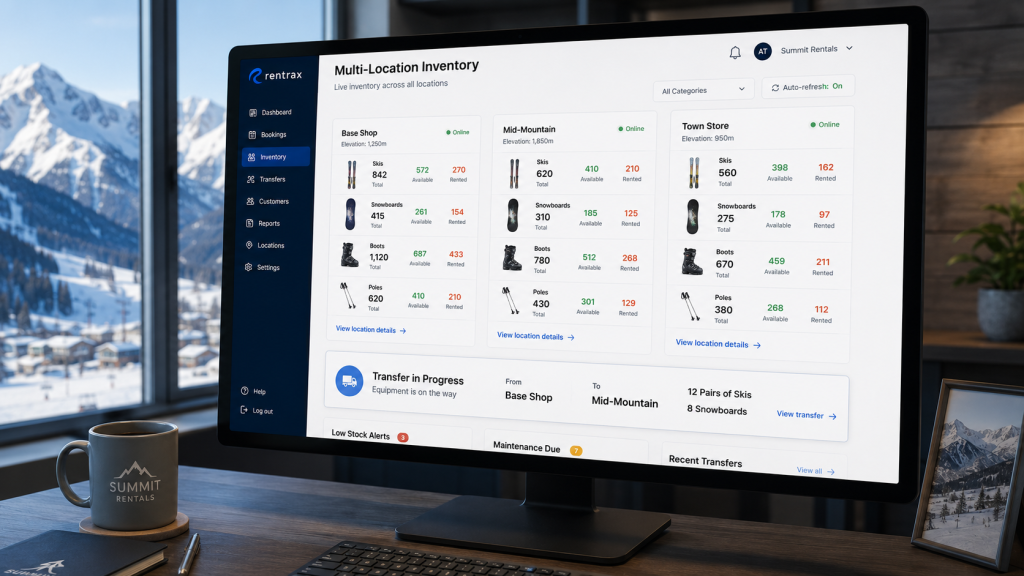
Ski rental operators frequently run more than one point of sale — a base-area shop, a mid-mountain location, an in-town storefront. Each one needs its own visible inventory, but a skier who rents from the base shop and returns at mid-mountain shouldn’t create a gap in either location’s records.
Without real-time inventory sharing across locations, the result is double-booked skis, staff calling each other to check stock, and avoidable downtime on equipment that’s actually available — just not where the system thinks it is.
- Live inventory synced across every location in real time, not on a batch delay
- Transfers between locations logged automatically when a customer drops off at a different shop
- Per-location reporting so you can see which shop is over- or under-stocked for a given week
- One customer record across locations — no re-entering renter info at every stop
Idea 4: Build a Maintenance Tracking System for Ski Tuning
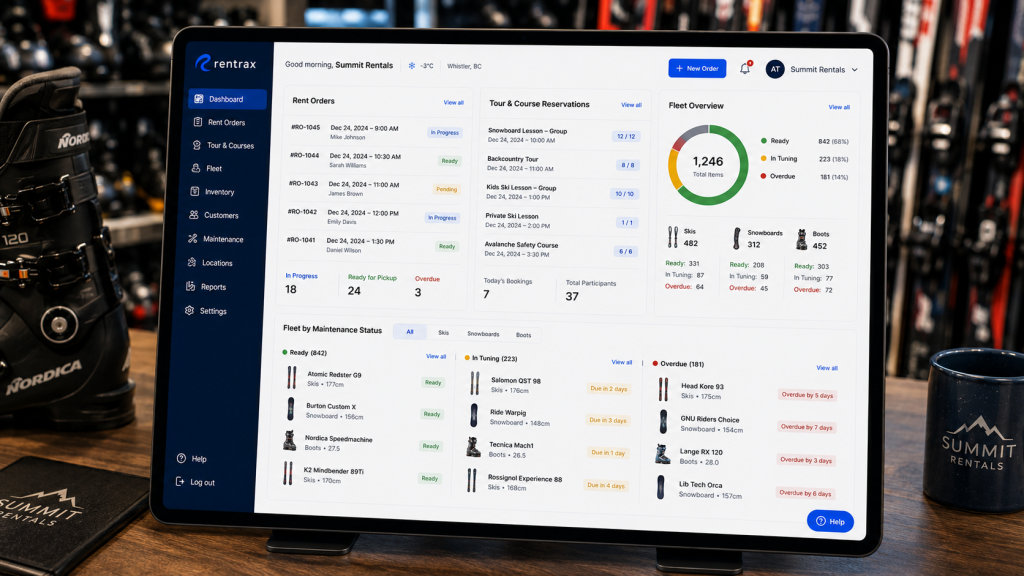
Skis and snowboards need regular tuning — edge sharpening, base waxing — to perform safely and rent well. Without a tracking system, operators tend to either over-tune (wasted labor cost) or under-tune (dull edges, unhappy customers, and in icy conditions, a real safety issue).
Tracking tune history per unit, tied to actual usage days rather than a fixed calendar schedule, lets you service equipment exactly when it needs it — not before, not after.
- Tune and wax history logged against each individual ski or board, not the category as a whole
- Maintenance scheduling triggered by usage days rather than guesswork
- Units automatically flagged and pulled from the rental pool when maintenance is due
- Maintenance cost tracking by unit to inform replacement timing for aging inventory
Idea 5: Make Group Bookings Effortless for Families and Ski Schools
A family of five needs five sets of skis, boots, and poles — each sized and DIN-set individually — and right now, in a lot of shops, that means five separate transactions stitched together by a stressed staff member during the morning rush.
Group booking tools that handle a family or a ski school class as one order, with each participant’s individual fitting and DIN data attached, turn a 20-minute ordeal into a few minutes at the counter.
- One order for the whole group, with individual sizing and DIN data per participant
- Custom renter fields per person (height, weight, ability level, boot sole length)
- Single payment and waiver flow for the whole group, signed once per participant digitally
- Particularly valuable for ski school operators booking 10+ participants at a time
Idea 6: Price for Peak Season Without Scaring Off Shoulder-Season Customers
Ski rental demand is extremely concentrated — December through March carries most operators’ annual revenue. Pricing flat year-round either leaves money on the table during peak weeks or prices out shoulder-season customers who’d rent if the price reflected lower demand.
- Higher daily rates during peak holiday weeks and weekends
- Multi-day discounts that reward longer bookings and reduce per-day staff overhead
- Shoulder-season pricing (early/late season) to keep utilization up when demand naturally drops
- Last-minute discounting on unbooked inventory within 24-48 hours to avoid zero-revenue idle days
Operational Challenge | How Rentrax Addresses It
Operational Challenge | How Rentrax Addresses It |
|---|---|
DIN setting liability | Digital DIN documentation tied to each rental, signed by the renter |
Course/lesson booking friction | Course bookings integrated with equipment rental in one order |
Multi-location double-booking | Real-time shared inventory across all locations |
Ski tuning neglected or over-serviced | Maintenance logging and scheduling by usage, not guesswork |
Group bookings taking 3x as long | Group booking tools — one order, multiple renters, individual fitting data |
Off-season revenue gaps | Dynamic pricing and multi-day discount tools |
How Rentrax Supports Ski & Snow Rental Operations
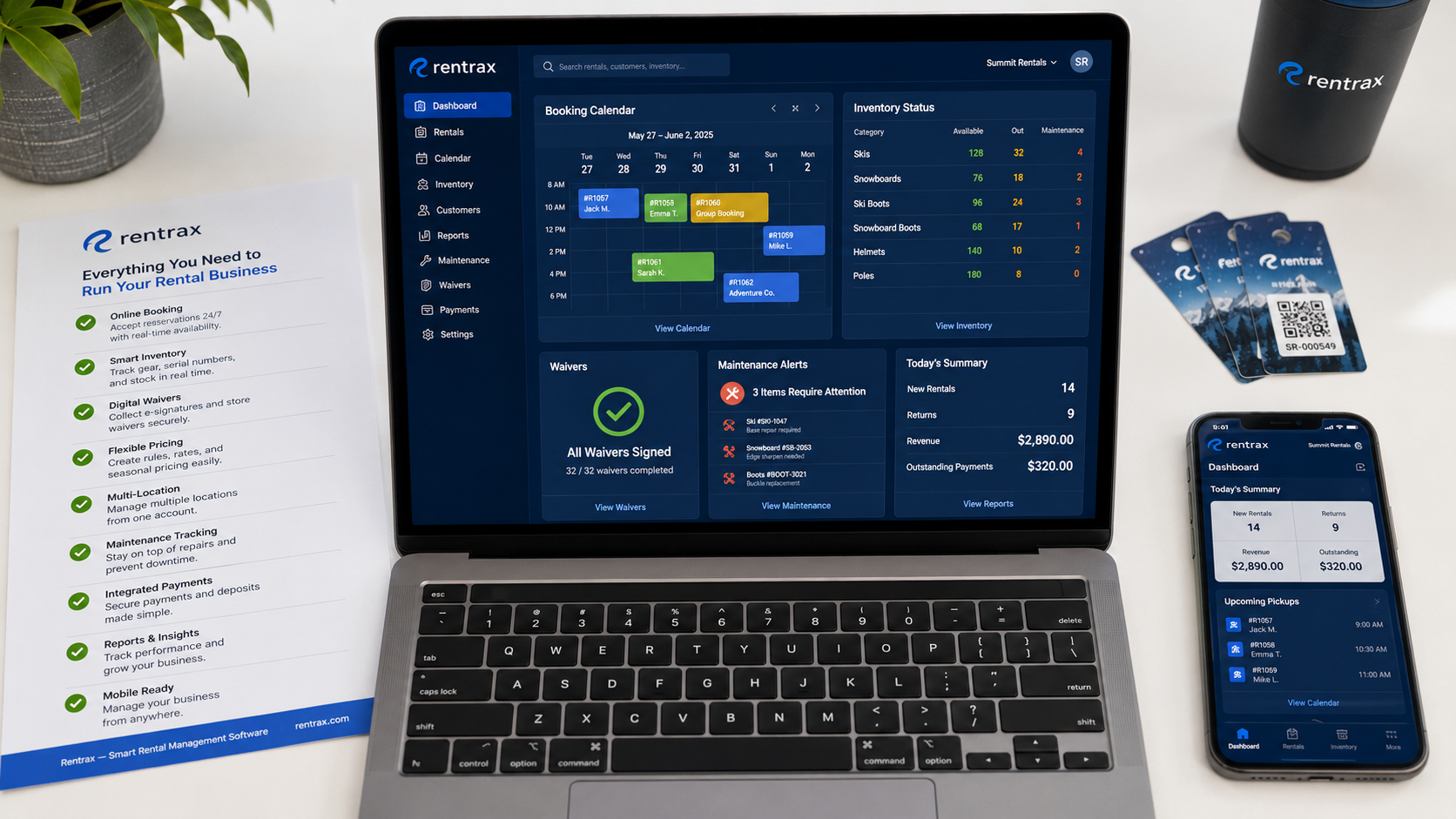
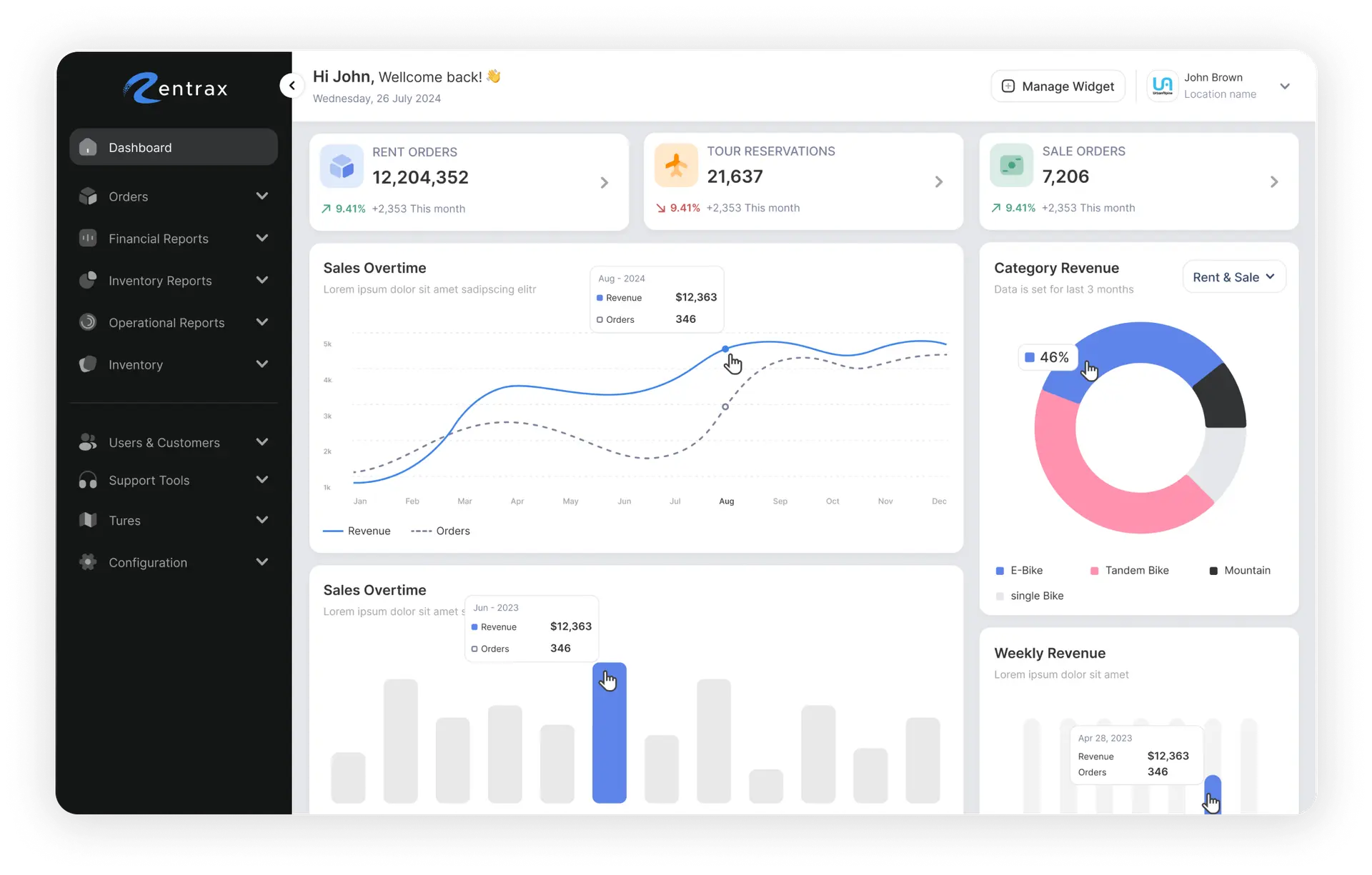
Rentrax is built for the operational realities of ski and snowboard rental — including DIN setting documentation, multi-location inventory, and the seasonal intensity that defines this category. Full fleet visibility, maintenance tracking, and group booking tools live in one platform, not three disconnected systems.
Frequently Asked Questions
-
How profitable is a ski rental business?
Profitability varies widely by location and scale, but well-run ski rental operations with strong peak-season utilization can achieve healthy margins despite the short operating window. The key variables are peak-season pricing discipline, multi-location utilization, and minimizing liability-related costs from DIN-setting disputes.
-
What is DIN setting and why does it matter for rental shops?
DIN setting refers to the calibrated release force of a ski binding, set according to the skier's weight, height, age, ability level, and boot sole length. It matters because an incorrectly set binding is a leading cause of rental-related injuries and the resulting liability claims — documentation of the correct setting and renter acknowledgment is essential protection for the shop.
-
How do ski rental shops avoid liability for binding-related injuries?
The strongest protection is a documented, repeatable DIN-setting process: calculate the setting using standard inputs, record it against the specific binding and renter, and capture a digital acknowledgment before the equipment leaves the shop. Paper-based or undocumented processes leave shops exposed when a dispute arises months later.
-
What's the best way to manage ski rentals across multiple mountain locations?
Real-time, shared inventory across all locations is essential — when equipment is checked out or transferred at one location, every other location needs to see that update immediately. Batch-synced or disconnected location systems are the most common cause of double bookings in multi-location ski rental operations.
-
How do ski shops handle group bookings for families and ski schools?
The most efficient approach treats a group as a single order with individual fitting data (size, DIN, ability level) captured per participant, rather than processing each person as a separate transaction. This cuts checkout time significantly during peak morning rush periods and is especially valuable for ski school operators booking large groups.